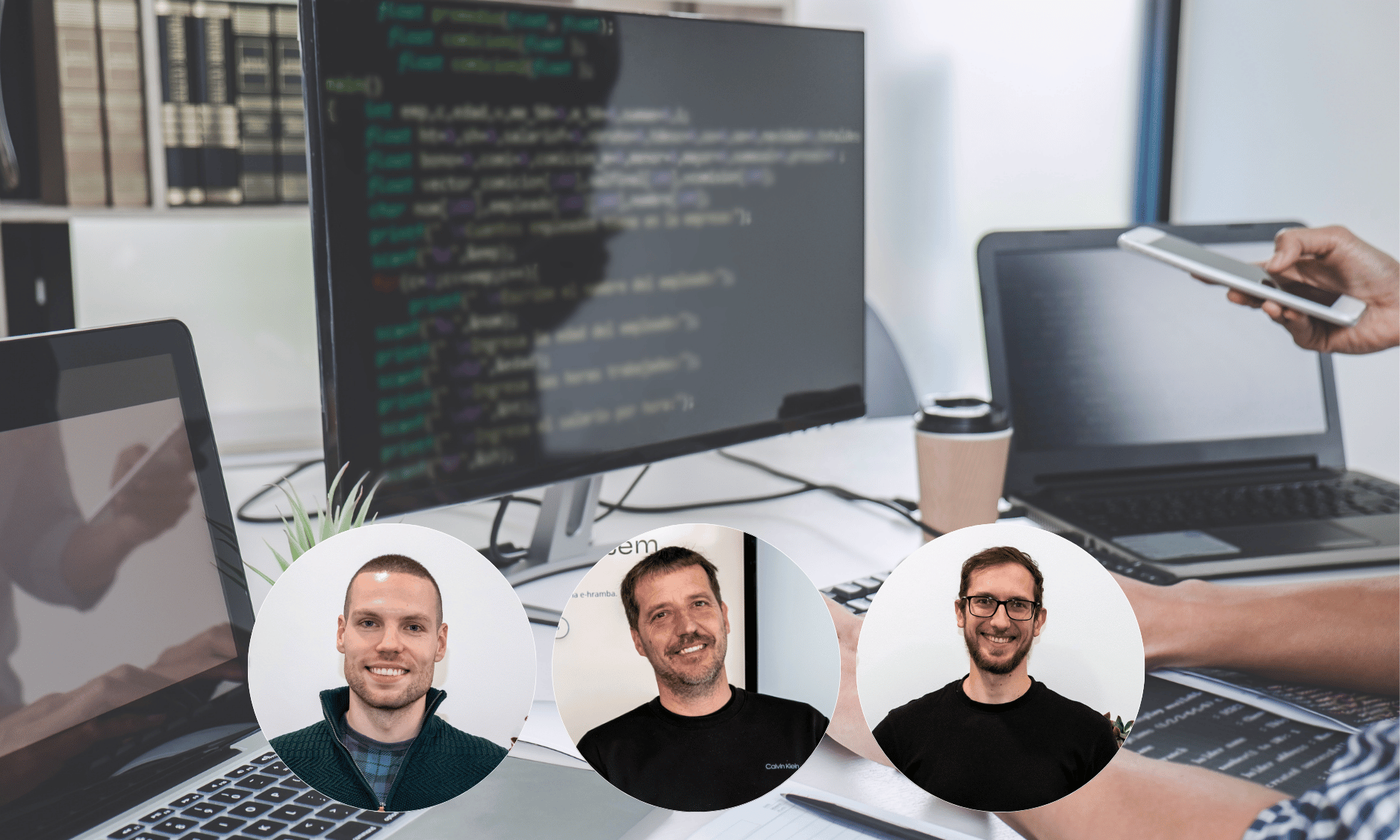
Behind the scenes with Mikrocop’s Business Solutions team
For Mikrocop’s 50th anniversary, we are not only talking about technology, but also about the people, knowledge and way of working that have been shaping the company for decades. The Business Solutions team is the team that brings InDoc EDGE into real business environments every day - into processes that need to work reliably, securely and in the long term.
In a conversation with the team, we looked behind the scenes of implementation projects: how they work, where the biggest challenges appear and why clients often see Mikrocop as a partner, not just a provider.
A team that connects business content and technology
The Business Solutions team brings together different profiles that constantly work together on projects. On one side, there are project managers and analysts who understand the business context, client requirements and the content of documents. On the other side, there are process architects who translate these requirements into working processes within InDoc EDGE.
Tatjana Jaklič, Head of the unit, explains: “In general, we have two profiles: project managers, who are very close to the client and the business content, and process architects, who are more technically oriented. But in practice, these roles are closely connected. We all need to understand both processes and documents.”
The key to success is not the division of roles, but the way the team works together. Projects start with a plan, but on a daily level they adapt to real project dynamics.
How implementation really works
A typical project rarely starts with all the answers. A large part of the understanding only happens when the client sees the solution in practice.
Sebastjan Zemljak emphasizes the importance of an early demonstration: “We show the basic solution very early. When the client starts using the system, the conversation moves from theory to practice.”
Instead of blindly following the offer, the project develops through dialogue. The team brings good practices from other environments, while also adapting to the client’s real needs. The goal is not perfect alignment with the original plan, but a solution that works in practice.
Customizations, migrations and the reality of projects
The approach to standard solutions depends on the area of use. For system documents, where ISO standards and regulations apply, the team usually relies on proven solutions. In other areas, for example invoice approval or internal rules, customizations are more common because of integrations and existing processes.
“For system documents, we practically do not change the solution. In other areas, we already know that customizations will be necessary,” explains Tatjana Jaklič.
This becomes especially clear in projects with short deadlines or higher risk. In such cases, a standard solution often means stability, while customizations are introduced in phases.
“If we changed a proven solution too much in time-limited projects, we would risk both the deadline and stability,” adds Andreja Vehar.
Migrations are one of the most sensitive phases. Moving to a new system often means that the client has already ended cooperation with the previous provider and no longer has full access or support.
“During a migration, the client has often already gone through a lot of uncertainty, complications and negotiations. Our task is to take what we receive and turn it into a safe and meaningful solution,” Tatjana emphasizes.
That is why data is not always ideally prepared. Some information needs to be added, some reconstructed, and sometimes it is necessary to accept certain limitations. The team’s focus is not on finding someone to blame, but on making a realistic assessment of what can be done immediately and what can be done later.
People before the system
If migrations are a technical challenge, changing the way people work is above all a human process. Replacing a system means entering the unknown, especially for users who have worked in the same environment for years.
“Migration also means a change in the way people work. This fear is very strong among users,” says Tatjana Jaklič.
That is why the team involves key users very early in the project. They get to know the solution before go-live, take part in shaping the processes and gradually get used to the system. The goal is not only a technically successful transition, but also a sense of safety and control.
The ideal client-side team and the reality of projects
The success of an implementation also depends greatly on cooperation on the client’s side. Ideally, the project includes three key roles: a person who understands the content and processes, a person with a clear mandate and management support, and someone with basic technical understanding who can connect business requirements with the system.
Such a setup enables faster decision-making, clearer communication and a better connection between business goals and technical implementation. In practice, however, ideal conditions are not always in place. In larger organizations, several departments may be involved without a single overall view. In smaller organizations, IT support is often limited, which means clients expect more guidance and direction from the provider.
The Business Solutions team understands these differences and leads projects based on the real situation, not ideal assumptions. Instead of focusing on missing roles, the team works with what is available and fills the gaps with explanations, support and clear agreements.
Tatjana Jaklič: “The key is that there is someone on the client’s side who really wants the new solution and is motivated to make it work.”
Such a person often becomes the link between departments, helps with decision-making and gives the project momentum that cannot be replaced by formal roles or technical knowledge alone.
When the project goes live
The end of the project does not mean the end of cooperation. After go-live, the team deliberately reserves time for intensive support on more demanding projects.
“In the first few weeks, we are practically in stand-by mode. That is when real needs and expectations become visible,” explains Sebastjan Zemljak.
Once the system stabilizes, communication moves to established channels, while content-related adjustments and upgrades remain part of the cooperation. Solutions are not “set and forget”. They continue to develop over time.
Projects that stay with you
Some projects remain memorable because of strong cooperation on the client’s side.
Tatjana highlights an example from healthcare: “We had a contact person who really took ownership of the solution. There were very concrete discussions and many good ideas. That is when you truly build the project together.”
A similar pattern appeared with a client from the banking sector, where the team took over a project in three months after the sudden departure of the previous provider.
“First stability, then improvements and the client understood that,” explains Tatjana. Positive feedback came from different levels of the organization, which was a clear confirmation that the right decision had been made.
Work where you have impact and a team beside you
What team members value most is the feeling that their knowledge can have a real impact on solving clients’ actual challenges. “The most interesting part is that I can talk to clients and help them find solutions,” says Sebastjan Zemljak.
The team works in an open environment with a lot of communication and dialogue.
“This is not a typical IT department where everyone sits quietly at their own desk,” adds Nejc Kovačič.
Special attention is also given to onboarding new colleagues - gradually, with the support of more experienced team members.
“If they are motivated and curious, they become independent very quickly,” says Tatjana Jaklič.
The story of the Business Solutions team is not a story of individuals, but of a way of working. InDoc EDGE is the tool that supports this and the team is the reason why solutions also work in practice.